
The Token Economics of AI Coding: $42,240 → $5,174 per Team
AI coding tools went metered-per-token in 2026 — GitHub Copilot on June 1. A 4-dev team burns $42,240/yr on flat-file context. A knowledge graph cuts that to $5,174. Here's the math, the EU AI Act angle, and the receipts.
In 2026 the bill for AI-assisted coding stopped being a flat seat and became a metered meter. GitHub Copilot moved every plan to usage-based, per-token billing on June 1, 2026 — and the $39/month Pro+ credit pool can drain in roughly an hour of intensive agentic coding. Cursor and Claude Code are usage-metered too. Microsoft reportedly burned a team's entire annual AI budget within months of a Claude Code pilot.
This is not an Anthropic problem, a Cursor problem, or a Copilot problem. It is a flat-file context problem: every tool re-feeds whole files into the model on every question. The fix is to stop sending whole files — and that is exactly what a knowledge graph does.
The scenario
A four-developer team on a 50,000-node enterprise application (~200k edges, ~180–250k LOC, ~600k tokens of code) burns roughly 12M tokens per developer per day — about $40/dev/day. That is calibrated against Anthropic's published ~$13/dev/day enterprise average, adjusted 3× for heavy agentic active coding, and validated by real team bills of $5k–$15k/month.
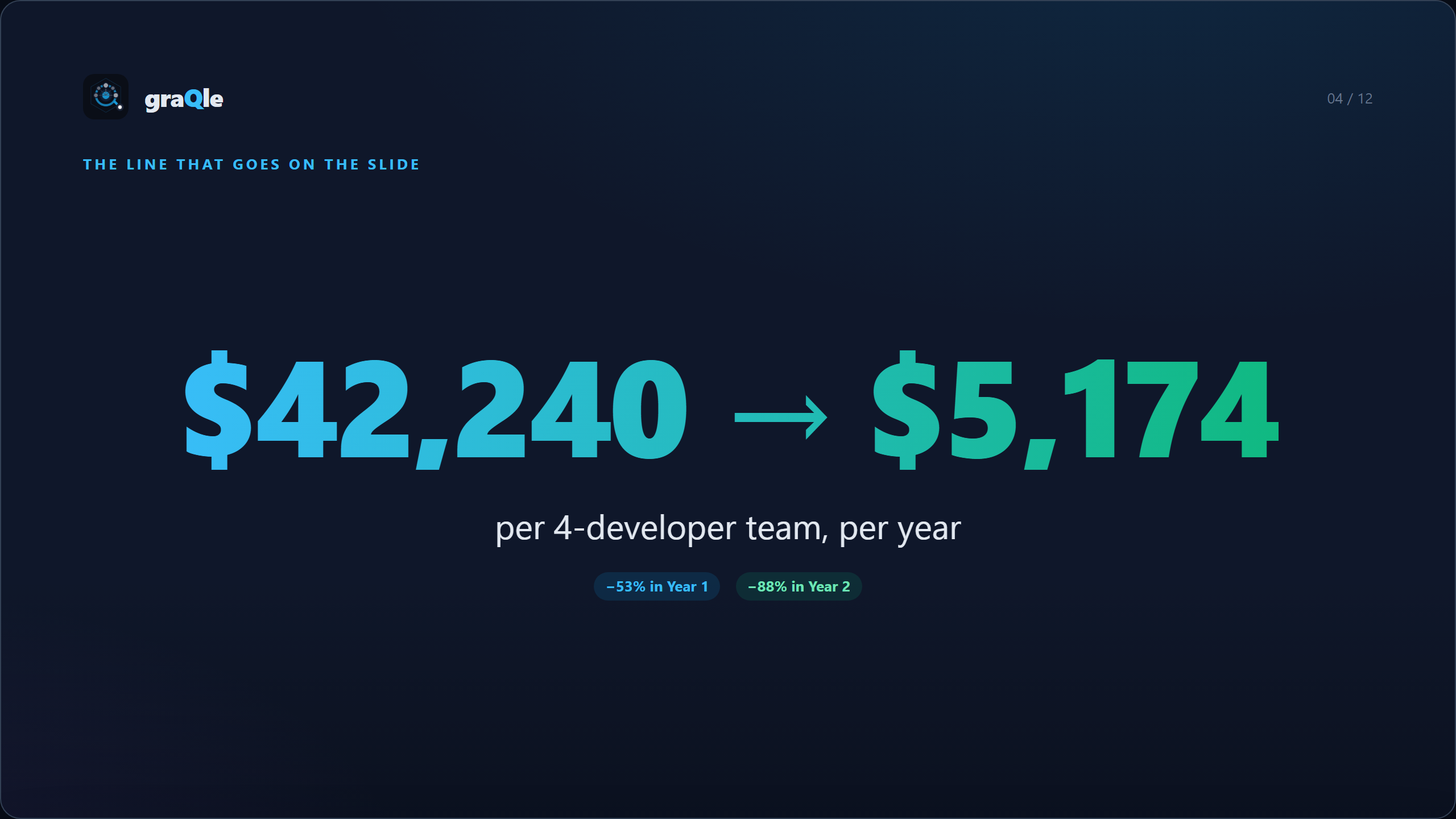
Three scenarios, one team, twelve months
| Scenario | $/dev/day | Annual (team of 4) | Saving vs A |
|---|---|---|---|
| A — Flat-file baseline | $40.00 | $42,240 | — |
| B — GraQle + Sonnet 4.6 | $18.82 | $19,874 | −$22,366 (−53%) |
| C₁ — GraQle + local SLM · Yr 1 | $16.60 | $17,530 | −$24,710 (−58%) |
| C₂ — GraQle + local SLM · Yr 2 | $4.90 | $5,174 | −$37,066 (−88%) |
GraQle activates only the relevant subgraph from your codebase's knowledge graph — typically 8–25k focused tokens versus 84k+ for a flat-file dump. Across a developer's day that nets an 88% token reduction, dogfooded on real graq_reason queries. Debugging wins biggest: graq_learn writes a failure pattern to the graph once, and future similar bugs activate the cached node instead of re-feeding the entire failure context. The graph gets cheaper as it learns.
It is not a marketing extrapolation
- ▹A biomedical knowledge-graph study (SPOKE, arXiv 2311.17330) found minimal-schema KG context plus embedding pruning achieves >50% token reduction without accuracy loss. GraQle applies the same technique to code.
- ▹A 2025 code-reasoning study confirmed context-aware token reduction in repair tasks cuts cost without degrading quality.
- ▹The inverse holds for multi-agent debate: 5 rounds × 4 agents costs 90–101× more tokens than single-agent reasoning. Every flat-file parallel-agent team pays this tax today.
The number is now authentic
As of GraQle v0.72.1, the dashboard's "Cost Saved" figure is computed from a single dated source of truth (graqle/pricing.py) at the real per-model input price — and it moves with the model you actually run. Published Anthropic pricing as of 2026-05-26: Opus 4.x $5/$25, Sonnet $3/$15, Haiku $1/$5 per million tokens.
| Model | $/1M in | $/1M out | Cost saved @ 88.2M tokens |
|---|---|---|---|
| Claude Haiku 4.5 | $1 | $5 | $88.20 |
| Claude Sonnet 4.6 | $3 | $15 | $264.60 |
| Claude Opus 4.8 | $5 | $25 | $441.00 |
EU AI Act-aligned by design
The same substrate that cuts the bill also produces the compliance trail. EU AI Act Article 26 — deployer obligations for high-risk AI — binds on 2 August 2026, requiring human oversight, logs kept for at least six months, and incident monitoring. Non-compliance carries fines up to €15M or 3% of global turnover. GraQle's tamper-evidence and audit trail is exactly the traceability Article 26 demands, generated automatically as you save tokens. For context, a single Article 26 fine would wipe out 354 years of this team's flat-file token spend.
Cost down. Speed up. Compliance in. Flat-file AI coding is a metered-token money fire — GraQle makes the bill 53–88% smaller, and proves the saving at the real per-model price.